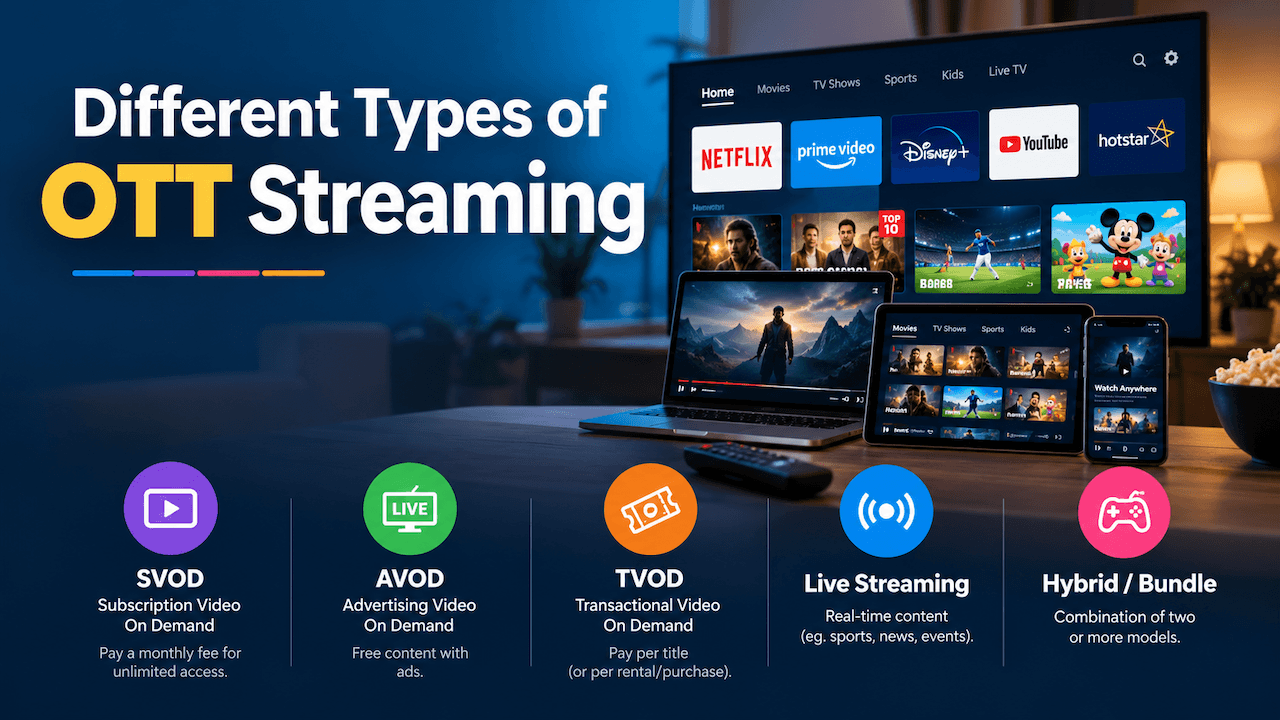
Different Types of OTT Streaming
Choosing among OTT streaming platforms is difficult when commercial targets conflict with live-video, rights, and device constraints. A service may look simple at the application layer, yet ingest, entitlement, advertising, and playback dependencies create very different operating demands. Over-the-top streaming services deliver video through internet connections rather than conventional cable, satellite, or managed IPTV paths. The right model follows monetization, programming rights, event latency, and the team’s ability to run a continuous media service.
This article compares the major platform models and their engineering implications. It also maps the video chain from contribution through playback, with attention to codecs, ad insertion, DRM, observability, and DVB-I. TVTechInsight approaches these decisions from both broadcast and IP delivery perspectives, where receiver behavior matters as much as cloud workflow design. The sections below help technical teams match service ambitions with operational reality.
Table of Contents
- What Are the Main Types of OTT Streaming Platforms?
- How Should Engineers Design OTT Streaming Services for Each Model?
- The Bottom Line
What Are the Main Types of OTT Streaming Platforms?
The main types of OTT streaming platforms differ by who pays, what content rights permit, and how video reaches screens. OTT streaming platforms commonly combine models, but each model creates distinct requirements for monetization, discovery, rights controls, and reliability. FOX One, Pluto TV, and OTTplay demonstrate broadcaster-led live delivery, free ad-supported channels, and multi-service aggregation.
| Model | Viewer Proposition | Main Engineering Focus |
|---|---|---|
| SVOD | Paid on-demand catalog | Billing, DRM, retention, discovery |
| AVOD | Free or lower-cost catalog | Ad decisioning, beacons, pod timing |
| FAST | Free scheduled IP channels | Playout, EPG, SCTE-35, ad insertion |
| Live OTT | Real-time sports or news | Latency, concurrency, blackouts |
| TVOD | Rental, purchase, premium event | Transaction rights, availability windows |
| Aggregator | Multiple services in 1 interface | Metadata, partner entitlement, support |
SVOD gives subscribers recurring access to an on-demand library, and research into OTT continuance intention among younger audiences shows that satisfaction and perceived enablers strongly influence whether subscribers keep paying month to month. AVOD removes or lowers the subscription barrier, but ad creatives and program content need compatible encoding profiles to avoid failures at ad boundaries.
ad-supported video on demand reproduces linear television through IP-delivered channels, often funded by commercial breaks. Pluto TV illustrates this model, where channel origination, playout scheduling, electronic program guide data, SCTE-35 cues, and scalable ad insertion shape the viewing experience. Live OTT services such as FOX One add low-latency delivery, event-scale capacity planning, redundant contribution paths, and geographic blackout enforcement.
TVOD relies on transaction entitlements that remain synchronized across applications and purchase states, a dynamic shaped by broader shifts in consumer behavior analysis toward OTT platforms as viewers move between rental, purchase, and subscription options. Aggregators require universal search, normalized metadata, partner billing rules, and explicit accountability when playback fails. OTTplay demonstrates the aggregation pattern, although its commercial plans are India-focused. Premium sports favor live OTT, catch-up libraries fit SVOD, free linear channels fit FAST, and regional-language catalogs often benefit from aggregation.
Before launch, teams should document which features are mandatory on day one and which can wait. A 24-hour news feed, a national sports final, and a film catalog have different failure tolerances, support loads, and release schedules.
How Should Engineers Design OTT Streaming Services for Each Model?
Engineers should design OTT streaming services as an end-to-end media operation, not as a player connected to a CDN. OTT streaming platforms require coordinated decisions across contribution, encoding, packaging, entitlement, delivery, device applications, telemetry, and customer support. A weak link in any layer can prevent a valid subscriber from reaching a licensed stream, which is why studies examining user experience and functional value in OTT video platforms link smooth technical performance directly to viewer satisfaction and continued usage intention.
A baseline architecture starts with redundant ingest from broadcast facilities, satellite, fiber, or managed IP circuits. Adaptive bitrate encoders create H.264, HEVC, or AV1 renditions renditions, while HLS or MPEG-DASH packaging produces manifests and segments for origin services and CDN distribution. DRM, authentication, entitlement rules, captions, alternate audio, and player telemetry then control access and reveal playback conditions, with monetized access typically configured through offer and bundle management systems that define how content is sold and unlocked.
Live sports need motion-aware bitrate ladders, low-latency targets, real-time metadata, and capacity reserved for sudden concurrency spikes. AV1 can reduce delivery bandwidth where device analytics show sufficient decoder coverage, while H.264 and HEVC preserve reach across older receivers and set-top boxes. TVTechInsight treats codec choice, broadcast contribution, IP delivery, and receiver capability as 1 connected chain rather than separate procurement decisions.
FAST and AVOD workflows depend on accurate accurate SCTE-35 signaling, stable manifest updates, measurement beacons, and uninterrupted ad transitions. Teams should validate captions, DRM licenses, audio formats, and decoder behavior across Roku, Apple TV, Android TV, browsers, mobile devices, and legacy hardware. Monitor time to first frame, rebuffer ratio, live latency, bitrate switches, entitlement failures, DRM errors, CDN errors, and ad-start completion. In 2026, digital video broadcasting can also align broadcast and OTT discovery through shared service lists and metadata.
Teams should define recovery objectives for ingest loss, origin failure, and entitlement outages before traffic arrives. Regular device testing and incident reviews help expose issues that lab playback tests may miss.
The Bottom Line
The bottom line for OTT streaming platforms is simple: select the service model around content rights, audience expectations, revenue design, and operational maturity. Reliable delivery depends on coordinated choices for encoding, advertising, entitlements, device validation, CDN routing, and observability. Before adding a codec, DVR feature, or monetization model, engineering teams should review the entire video chain and identify its weakest dependency. TVTechInsight provides a useful systems-level lens for connecting broadcast infrastructure with modern IP streaming operations.