IP Migration Guide: Modernizing Your Broadcast Headend for 2026
Aging SDI routers and satellite dishes are running out of road, and most headend managers already feel it. Spectrum sell-offs, rising transponder costs, and growing channel counts are pushing every broadcast engineer toward one question: how do I move my headend to IP without breaking live operations? This IP migration guide to modernizing your broadcast headend for 2026 answers that question directly.
This guide covers the technical building blocks that matter most right now. We will walk through SMPTE ST 2110 and PTP timing, compare SRT, HEVC, and JPEG XS for contribution transport, and map out the edge-core-cloud architecture that most modern facilities now run. We also cover security, resilience, and a phased migration plan you can actually present to management. By the end, you will have a practical framework for planning your own transition, whether you run a regional station group or a national sports network. TVTechInsight focuses on this exact intersection of broadcast reliability and IT-style networking, so let’s get into the details.
Key Takeaways
-
SMPTE ST 2110 with PTP timing (ST 2059) forms the technical backbone of any IP-native headend, replacing SDI’s single-cable model with independently routed video, audio, and data streams.
-
SRT paired with HEVC handles cost-effective wide-area contribution, while JPEG XS serves latency-critical multi-camera production where every frame counts.
-
Edge, core, and cloud tiers, tied together with NMOS orchestration, now define how modern broadcast networks distribute processing and control.
-
Phased migration, backed by SDI-to-IP gateways and clear KPIs like latency and provisioning time, lowers risk while proving return on investment to leadership.
What Is Driving Broadcast Headends to Migrate to IP in 2026?
Broadcast headends are moving to IP because satellite capacity keeps shrinking while channel counts keep growing, and that math no longer works on legacy infrastructure. C-Band spectrum auctions have pushed broadcasters, cable networks, and station groups to rethink transponder-dependent distribution, since available satellite capacity keeps tightening and lease costs keep climbing. Add in Ku-band rain fade issues and aging SDI routers that cannot scale past their physical port count, and you get a hard deadline rather than a someday project, a transition explored further in a whitepaper on efficient migration from SDI to IP/Ethernet infrastructure.
The operational upside makes the decision easier to justify internally. Moving to IP cuts provisioning time for a new channel from days of physical rewiring down to minutes of software configuration, and it lets facilities mix equipment from multiple vendors instead of locking into one supplier. Consolidating satellite and RF racks also reduces power draw and floor space, which matters for both budget and sustainability reporting. These combined pressures, spectrum scarcity on one side and clear operational gains on the other, explain why 2026 is shaping up as a turning point year for headend modernization.
How Does SMPTE ST 2110 Replace SDI in Modern Headends?
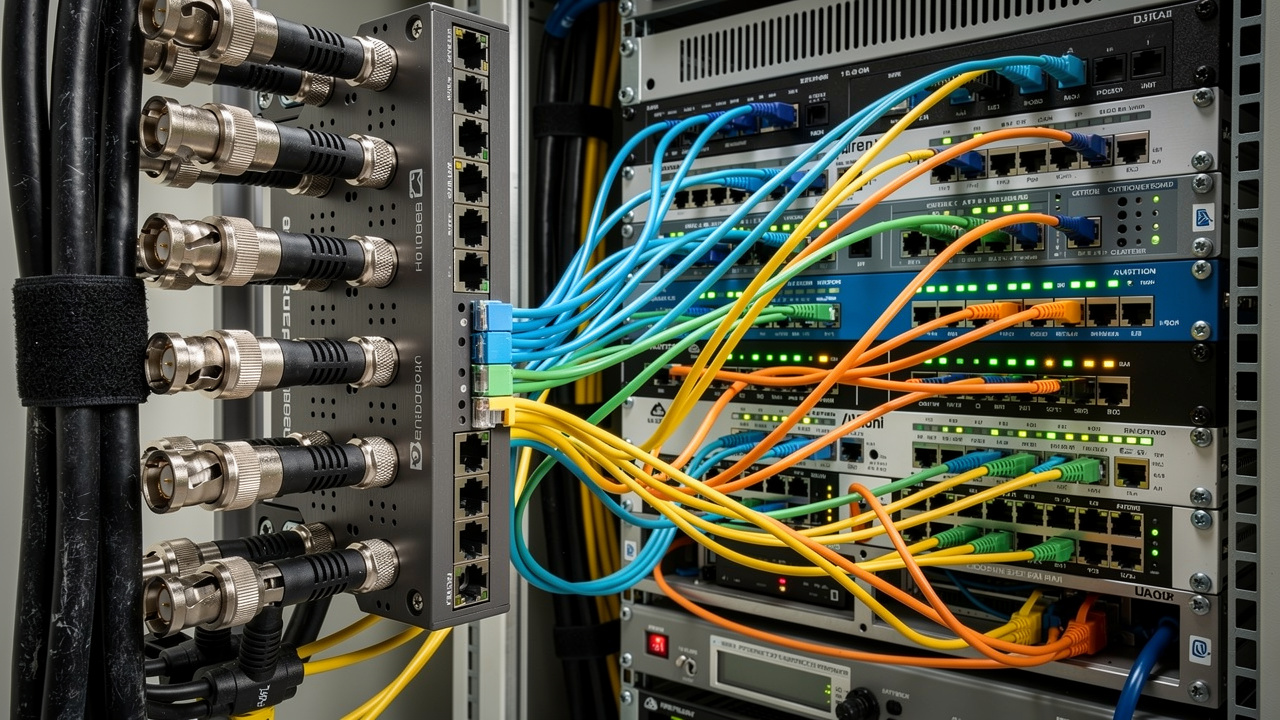
SMPTE ST 2110 replaces SDI by splitting video, audio, and ancillary data into separate IP streams instead of bundling everything onto one serial cable. Think of SDI as a single delivery truck carrying every package to the same address, while ST 2110 gives each package its own courier that can take a different route. This separation means you can route a camera’s video one way and its audio another way, process each independently, and scale capacity by adding network ports instead of physical cable runs.
The tradeoff is that this flexibility depends entirely on precise timing, because once essences travel as separate RTP streams, nothing automatically keeps them aligned the way a single SDI cable naturally does. That is where PTP, the Precision Time Protocol defined under IEEE 1588 and profiled for broadcast under SMPTE ST 2059, becomes non-negotiable. PTP distributes a shared clock reference across every device on the network, giving IP infrastructure the same frame-accurate synchronization that genlock provided in baseband systems. Skip proper PTP distribution, and you get lip-sync drift, misaligned switching, and quality problems that are hard to diagnose after the fact. Engineers planning a migration need to budget real time for PTP grandmaster placement, boundary clock configuration at every switch hop, and testing across edge-to-core links before trusting any ST 2110 flow for live production.
Understanding the ST 2110 Sub-Standards
The ST 2110 family breaks into specific sub-standards that engineers configure individually during deployment, and knowing what each one does keeps setup from feeling overwhelming.
-
ST 2110-20 handles video transport.
-
ST 2110-30, which aligns with the AES67 audio standard, handles sound.
-
ST 2110-40 carries ancillary data like closed captions and timecode.
-
ST 2110-21 governs traffic shaping, controlling how packets burst onto the network so switch fabric does not choke and jitter stays within acceptable bounds.
For sizing purposes, plan on roughly 2.5 Gb/s per uncompressed 1080p60 stream at 10-bit 4:2:2, which quickly adds up across a multi-channel facility.
Which Transport Protocol Fits Your Contribution Workflow?
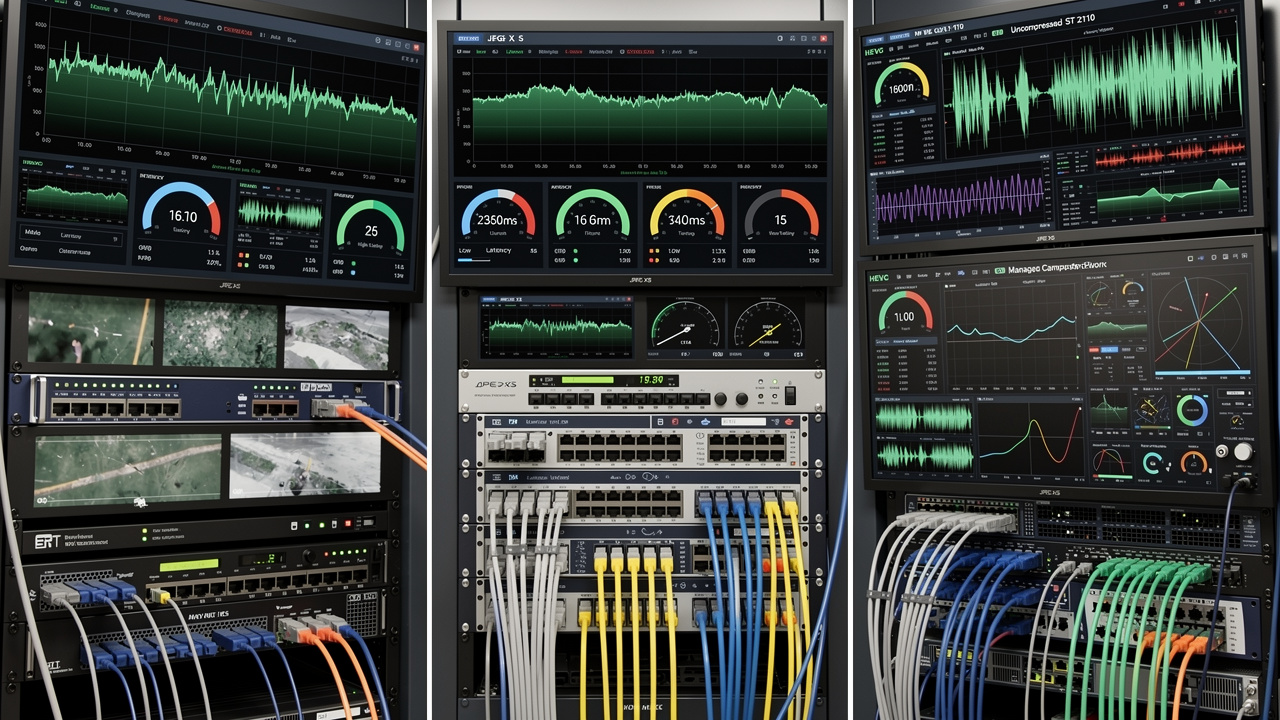
Choosing between SRT, HEVC, and JPEG XS comes down to one question, which is whether your link runs over a managed network or an unpredictable wide-area connection. ST 2110 performs best on campus networks where you control every switch and cable, but contribution feeds crossing the public internet or shared WAN links need a different approach built for packet loss and variable bandwidth. SRT (Secure Reliable Transport) handles that job by adding encryption, error recovery, and connection management on top of whatever codec you pair it with. HEVC, often run alongside SRT, cuts bitrate roughly in half compared to older AVC encoding while still supporting resolutions up to 16K, making it a practical fit for remote contribution where bandwidth costs money. JPEG XS takes a different path entirely, targeting near-lossless quality with latency low enough for live, multi-camera switching, which makes it the better choice when a production team cannot tolerate even a few frames of delay. Most facilities end up running a hybrid model, where cost-sensitive WAN links use SRT and HEVC, and latency-critical core paths use JPEG XS or uncompressed ST 2110.
SRT and HEVC for Wide-Area Transport
SRT and HEVC work well together for distribution over networks you do not fully control, since SRT adds AES-256 encryption, ARQ-based retransmission for lost packets, and connection bonding across multiple internet links. This combination typically delivers latency in the range of tens to a few hundred milliseconds, depending on how much forward error correction overhead and bonding configuration you apply. For a regional affiliate sending a remote sports feed back to a home studio over a business internet connection, this setup offers a reliable, budget-friendly alternative to a dedicated satellite uplink.
JPEG XS for Low-Latency Remote Production
JPEG XS earns its place in multi-camera REMI workflows because it delivers visually lossless compression without the generational quality loss that repeated HEVC encoding introduces over a production chain. Where HEVC trades some latency and quality for massive bandwidth savings, JPEG XS trades bandwidth savings for near-instant, sub-frame delay that live switching operations depend on. If your team runs remote production with multiple cameras feeding a central switcher, JPEG XS keeps the production feel close to what a local SDI truck would deliver.
How Should You Architect Edge, Core, and Cloud Infrastructure?
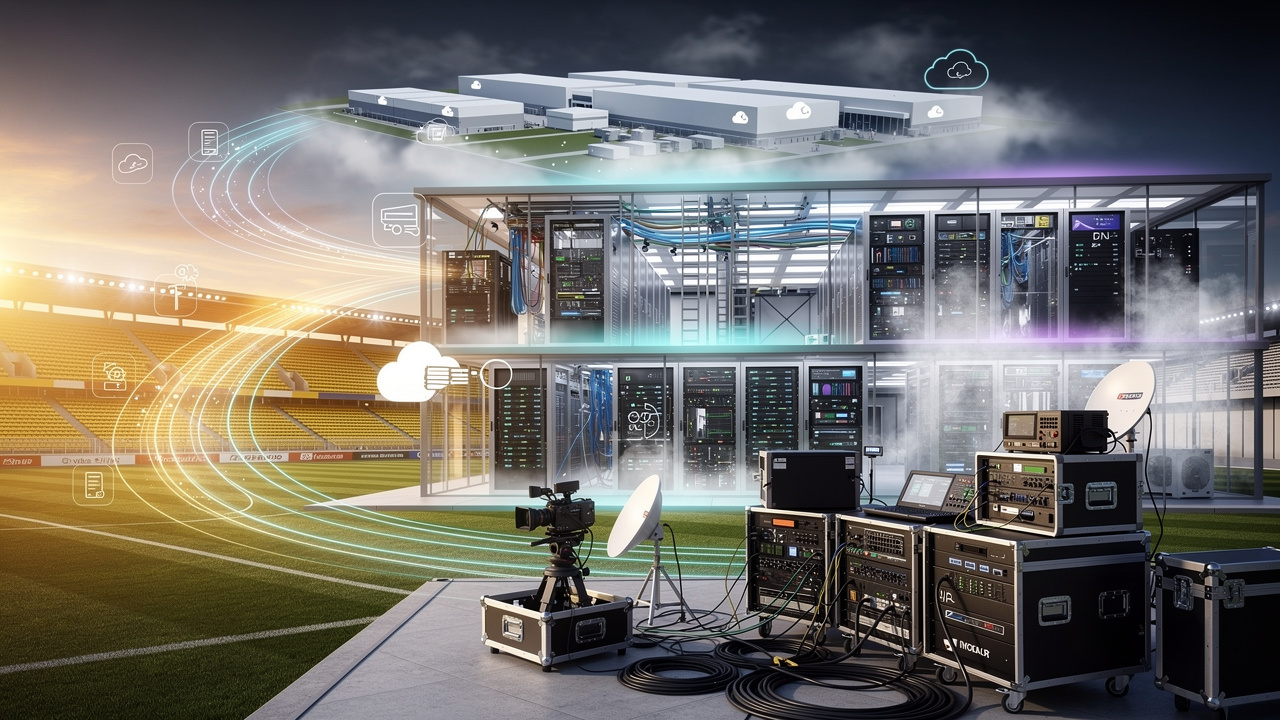
Modern broadcast networks split processing across three tiers, with edge handling capture, core handling aggregation and switching, and cloud absorbing elastic workloads that do not need to run on dedicated hardware around the clock, a structure outlined in detail in broadcast network modernization guidance for IP and cloud transitions.
-
Edge equipment sits at stadiums, remote venues, or flypack kits, where compact encoders and SDI-to-IP gateways convert camera and audio signals into packetized streams for transport back to the facility.
-
Core infrastructure, usually housed at the main broadcast center, runs high-density gateways that aggregate those incoming feeds, handle transcoding, and manage the security and encryption termination that protects content as it moves through the facility, following design patterns laid out in the Cisco IP Fabric for Media design guide.
-
Cloud resources step in for tasks like graphics rendering, playout, or distribution encoding during traffic spikes, letting a facility handle a major sporting event without permanently over-building on-premises capacity for demand that only shows up a few times a year.
Tying these three tiers together requires orchestration, and that is where NMOS (Networked Media Open Specifications) earns its keep. NMOS IS-04 and IS-05 give devices from different manufacturers a common way to discover each other and manage connections, which matters enormously once you have encoders from one vendor talking to gateways from another. Estate management platforms layer on top of that, exposing metrics and centralized dashboards so engineers can monitor edge, core, and cloud resources as one system rather than three disconnected islands.
What Security and Resilience Measures Protect IP Headends?
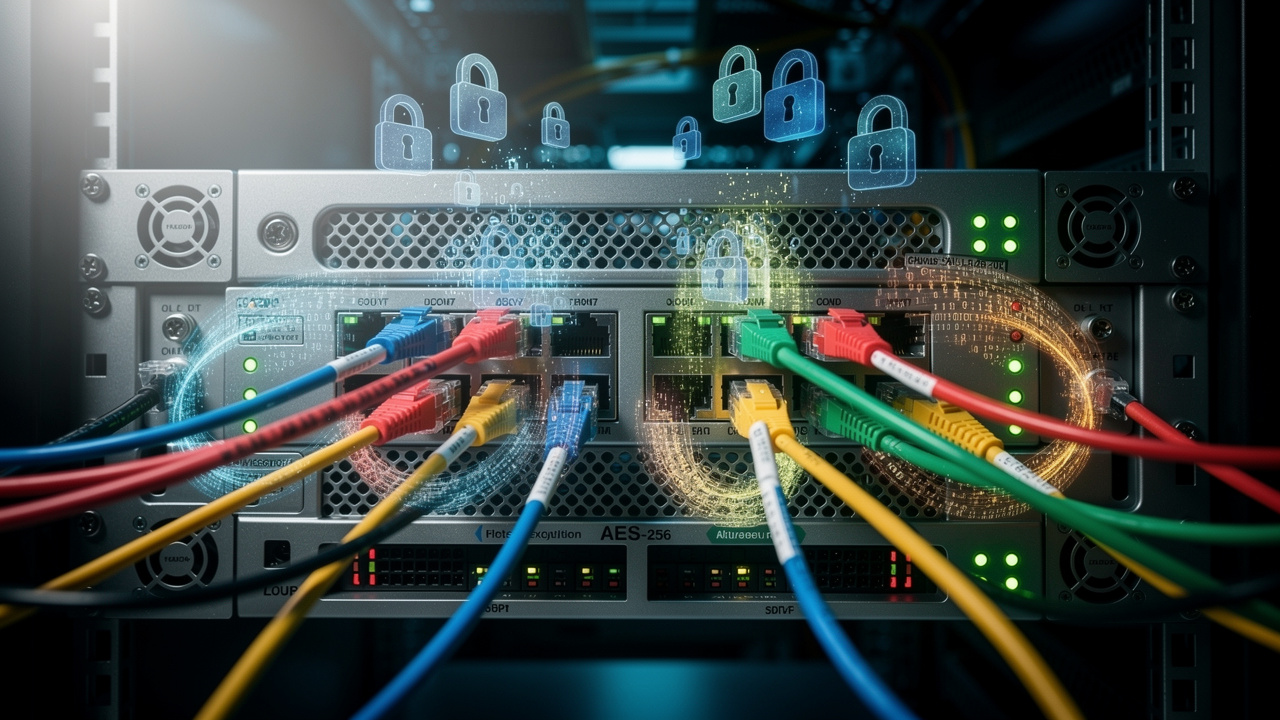
IP headends need layered protection because moving media onto shared network infrastructure expands the attack surface well beyond what a closed SDI or satellite system ever faced. ST 2022-7 seamless protection switching handles resilience by sending duplicate streams over two physically separate network paths, so a fiber cut or switch failure on one path does not interrupt the broadcast. SRT’s built-in ARQ mechanism adds another layer by retransmitting lost packets on unmanaged WAN links, while IP-FEC (forward error correction) recovers lost data mathematically without waiting on a retransmission round trip. Used together, these mechanisms can match or beat the reliability broadcasters got used to with satellite and microwave contribution paths.
Security has to cover more than just path redundancy, though. Every contribution and distribution link should run AES-256 encryption or an equivalent standard, and edge gateways need identity and access controls so only authorized devices can inject content into the network. Centralized key management ties this together, giving engineering teams one place to manage credentials across edge, core, and cloud rather than scattering access control across dozens of individual devices.
How Do You Plan a Phased Satellite-to-IP Migration?
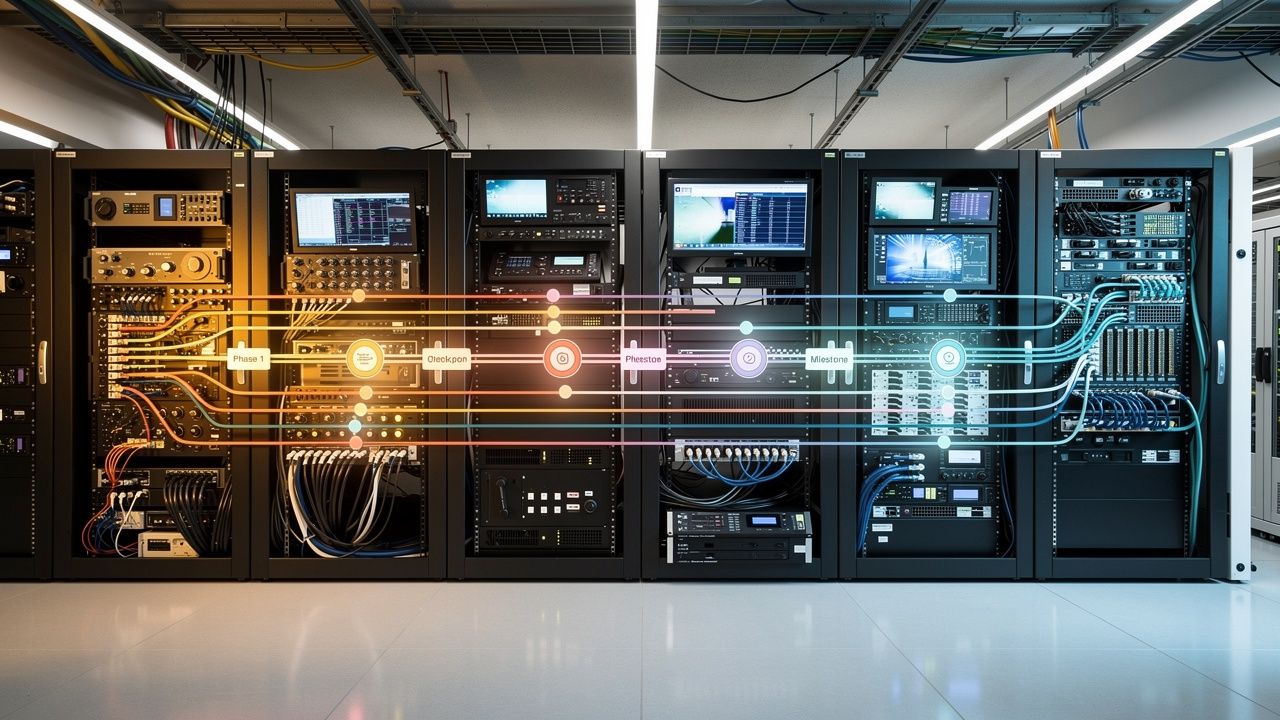
A phased migration works best when you start with a full audit of existing signal paths, since you cannot plan a transition without knowing exactly what you are moving and which feeds absolutely cannot tolerate downtime.
-
Classify every link by latency tolerance, quality requirement, and uptime need, then identify which ones are safe candidates for an early move and which ones need a longer runway.
-
Run new IP infrastructure in parallel with existing satellite or SDI paths for a defined test window, giving your team a safety net to fall back on if something does not perform as expected.
-
Use SDI-to-IP gateways to bridge legacy equipment into the new network gradually, so you are not forced into a single cutover weekend across an entire facility.
Once the new paths are live, track a focused set of KPIs to prove the migration delivered what you expected. End-to-end latency per signal path confirms production requirements are being met, watts-per-stream shows the efficiency gain from consolidated hardware, and mean time to provision a new feed demonstrates the software-driven speed that justified the project in the first place. Packet loss under failover conditions rounds out the picture, confirming your resilience mechanisms actually work when a path degrades rather than just looking good on paper.
Final Thoughts
IP migration for a broadcast headend is not a weekend forklift swap, it is a staged process built on standards like ST 2110, transport choices like SRT and JPEG XS, and a three-tier architecture that spreads processing across edge, core, and cloud. Treat it as a series of deliberate steps rather than one giant leap, and the risk drops considerably while the operational payoff still arrives on schedule.
The best advice for any engineering team starting this process is to begin with an honest infrastructure audit and a small pilot deployment, maybe one venue or one distribution channel, before committing to a facility-wide rollout. Codec choices made during this process matter just as much as network architecture, so it is worth reading our HEVC vs AV1 codec analysis alongside this guide to make sure your compression strategy lines up with your new IP-based pipeline from day one.
Frequently Asked Questions
What Is The Difference Between SMPTE ST 2110 And Traditional SDI?
SDI carries all video, audio, and ancillary data on a single serial cable, bundled together as one signal. ST 2110 separates those same elements into independent IP streams that route separately across a network, giving engineers granular control over each essence while requiring precise PTP timing to keep everything synchronized.
How Much Bandwidth Does An IP-Based Headend Need Compared To SDI?
Uncompressed 1080p60 video at 10-bit 4:2:2 needs roughly 2.5 Gb/s per stream over IP, similar to the raw bandwidth SDI already handles. Compression with HEVC or JPEG XS cuts that requirement by an order of magnitude, making compression worthwhile for WAN links or bandwidth-constrained facilities.
Can I Migrate To IP Without Replacing All My SDI Equipment At Once?
Yes, SDI-to-IP gateways let you bridge legacy baseband equipment into a new IP network without replacing everything simultaneously. This approach supports incremental migration, letting you move specific signal paths first while older equipment keeps running until it reaches end of life.
What Skills Do Engineers Need For IP-Based Broadcast Operations?
Engineers need solid IP networking knowledge, PTP timing expertise, and a working understanding of codec and transcoding tradeoffs. Software orchestration skills matter too, since day-to-day operations shift from physical patching toward telemetry-driven, API-based workflows that manage infrastructure at scale.
How Long Does A Typical Headend IP Migration Take?
Timelines vary widely based on channel count, how long you run parallel operation periods, and how ready your staff is for the new workflows. A single-facility migration might take several months, while a multi-site, hundreds-of-channel transition can stretch well over a year.
Is Cloud Playout Reliable Enough For Live Broadcast?
Hybrid models work best, keeping always-on, latency-critical playout on dedicated on-premises hardware while using cloud resources for burst capacity during major events. This balance gives you deterministic reliability where it matters most, plus elastic scaling when demand spikes unexpectedly.